
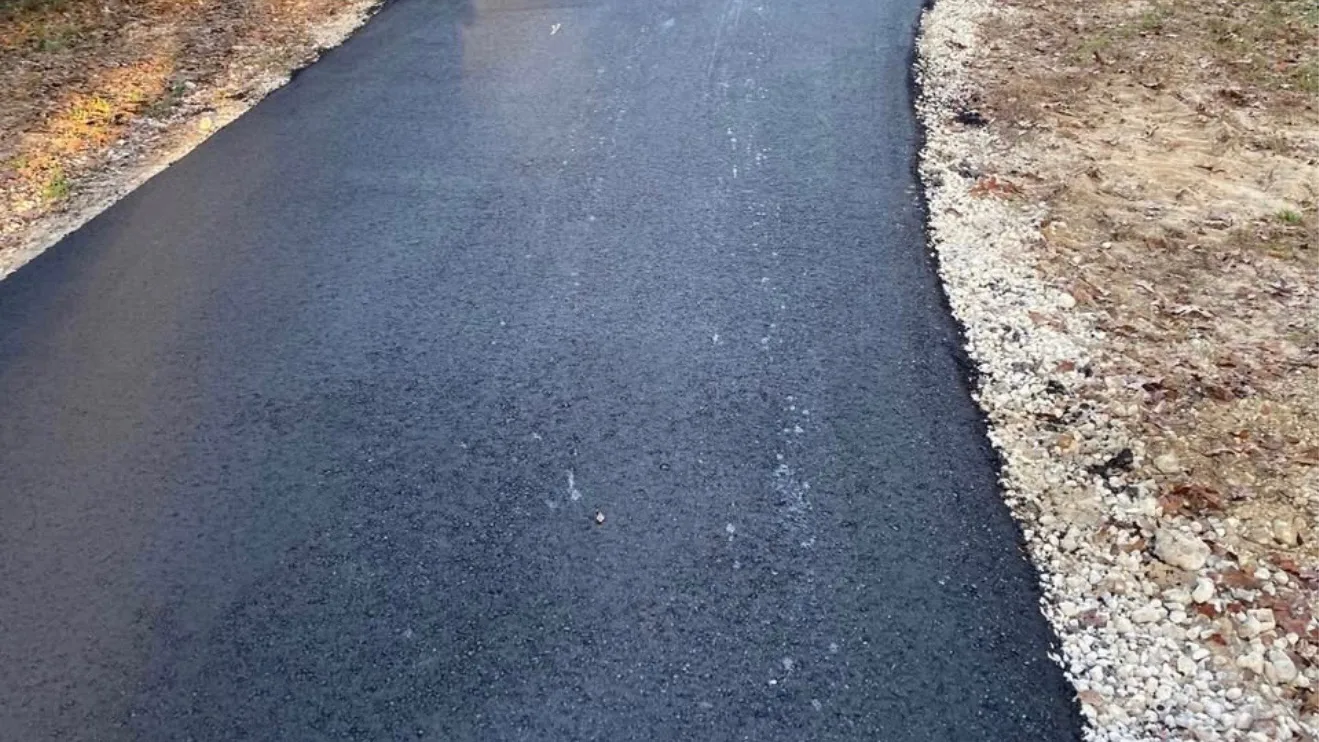
What Does an Asphalt Millings Driveway Cost?
Published cost guides put asphalt millings at roughly $10 to $25 a ton picked up, and $25 to $55 a ton delivered. An installed millings driveway runs about $1 to $8 a square foot across those guides. One ton covers about 64 to 80 square feet at 3 inches compacted.
Those are market numbers, not our price list. A millings job prices on the tons, the site work and the mileage. This post shows where those published ranges come from.
What are asphalt millings?
Millings are old pavement, ground up and used again. Federal pavement guidance calls it reclaimed asphalt pavement, or RAP: “the term given to removed and/or reprocessed pavement materials containing asphalt and aggregates.”
A milling machine shaves the old surface off a road or a lot, up to 2 inches in one pass. The material is then crushed and screened.
The result, in the same guidance, is “high-quality, well-graded aggregates coated by asphalt cement.” Every piece of rock carries a film of old asphalt. That film is why asphalt millings knit together under a roller instead of staying loose like clean gravel.
Federal guidance also reports that the asphalt cement in recycled pavement “has a significant strengthening effect over time.”
What do asphalt millings cost per ton, per load and per square foot?
What national cost guides published for 2026:
| What you are buying | Published range | What the number covers |
|---|---|---|
| Millings picked up, per ton | $10 to $25 a ton | material only, you haul it |
| Millings delivered, per ton | $25 to $55 a ton | material plus the haul |
| Millings by the load | $30 to $100 for 3 to 5 tons; $140 to $320 for 14 to 16 tons | material only, before the haul |
| Millings driveway, installed | $1 to $8 a square foot | material, grading, spreading, rolling |
| New hot mix asphalt, per ton | $90 to $200 a ton | material only |
| New asphalt driveway, installed | $7 to $15 a square foot | paving with light grading |
| Gravel and road base, per ton | $12 to $65 a ton | material only, by the rock |
The installed range is wide because the guides disagree. Two put a recycled asphalt driveway at about $1 to $4 a square foot. Another prices an installed millings drive at $3 to $8.
Haul distance is the reason. Millings are heavy and low in value per ton. Move them far enough and the truck costs more than the rock.
Common base gravel runs about $12 to $25 a ton in the same guides. Caliche shows up near $32 a ton and crushed stone near $65. Millings are usually the lower material number, but not always.
How far does a ton of millings go?
Start with a sourced density. Federal pavement guidance reports compacted recycled asphalt at 100 to 125 pounds per cubic foot.
- A ton is 2,000 pounds. At 100 pounds per cubic foot, a ton is 20 cubic feet. At 125 pounds, it is 16 cubic feet.
- Three inches is a quarter of a foot. Twenty cubic feet spread a quarter foot deep covers 80 square feet. Sixteen cubic feet covers 64 square feet.
- So one ton covers about 64 to 80 square feet at 3 inches compacted. At 4 inches it covers about 48 to 60 square feet.
National cost guides round this to “approximately 80 square feet with a 3-inch thickness.” That sits at the light end of the range.
Run your own drive. A drive 12 feet wide and 60 feet long is 720 square feet. At 4 inches compacted, that is 12 to 15 tons. At $10 to $20 a ton, the material alone is about $120 to $300 before the haul.
Millings or road base?
Road base, what TxDOT calls flexible base, is crushed rock built to a spec. Texas road work treats millings as an ingredient in that rock, not a replacement for it. The flexible base item allows recycled material only when the plans show it. Then it caps the amount: “do not exceed 20% RAP by weight, unless otherwise shown on the plans.”
There is a reason for the cap. Federal guidance reports that the asphalt coating on the rock “inhibits compaction.” Compacted density drops as the millings share of a base goes up, and so does bearing capacity.
As a load-carrying layer under something else, crushed road base is the stronger material. As a finished surface you drive on and look at, millings give you a dark, locked-up top that loose gravel does not.
Millings or hot mix asphalt in Texas heat?
Hot mix is a designed product. TxDOT calls it “a compacted, dense-graded mixture of aggregate, asphalt binder, and additives mixed hot in a mixing plant.” It is laid hot and rolled into one solid mat.
Millings are an aggregate. They go down cold, get watered and get rolled. The surface stays an aggregate surface, so material works toward the edges and the low spots. It gets regraded instead of resurfaced.
Heat is the part people ask about. The Madison County weather station averages about 100 days a year at or above 90 degrees. You will hear that millings melt back together in the summer sun. No primary source backs that.
For a drive you want smooth, sealed and edged at the house, hot mix asphalt paving is the buy. For a long ranch drive that has to stop the mud, millings do the job for less.
How are millings compacted, and how long do they last?
Compaction is the job. Cost guides call for building a 4-inch compacted surface in two lifts of about 2 inches. Each lift gets several roller passes, with water to help the fines lock up.
TxDOT’s flexible base spec shows what compacted means on a road. The target is 100 percent of maximum dry density, held within 2 percent of optimum moisture. Rollers work at 2 to 6 miles an hour. A ranch drive is not a state highway, but the levers are the same: moisture and density.
Life span is thinner ground. No engineering source publishes a service life for a millings driveway. Cost guides say to look the surface over every 3 to 5 years. Plan on re-compaction when it starts to loosen. For contrast, the Asphalt Institute puts a well built hot mix driveway at “trouble-free service for up to 20 years.”
Where does a millings driveway fit, and what is it not?
Millings fit long rural and ranch driveways, turnarounds, equipment and RV pads, shop yards and back lanes. They fit a muddy dirt drive or a thin gravel drive that needs a harder top, and private roads where a smooth sealed surface is not the point.
Millings are not hot mix. They are not the surface for a striped commercial lot. Stalls, fire lanes and accessible spaces need real pavement to hold paint. They are not a full-depth road base either, per that 20 percent cap.
Can you chip seal over millings later?
Yes, and it is the common upgrade path. A chip seal is emulsion sprayed down, rock spread over it, then rolled in. TxDOT calls it a surface treatment. It “provides a roadway with the least expensive permanent type of bituminous surface.”
The catch is underneath. TxDOT’s own picture is a surface treatment over a crushed stone base. Over millings, the surface has to be shaped, tight and well compacted first. Get the grade and the drainage right now, and a chip seal can go on later.
Season matters too. TxDOT will not let a standard seal coat go down below a 60 degree surface. With polymer-modified binder the floor is 70 degrees. That makes chip seal warm-weather work in the Brazos Valley.
Getting a real number for your drive
A web page cannot price your driveway. The tons come off the size and the depth, the rest off the site work and the mileage from North Zulch.
We deliver millings by the load, and we spread, grade and roll them on driveways, ranch roads, lots and pads. See millings driveways and delivery for how the work runs. Call or text (979) 595-5944 and we will come out, look at the site and give you a free estimate.