What Does Texas Require When You Stripe a Parking Lot?
Texas runs on the 2012 Texas Accessibility Standards, and for parking they read the same as the 2010 ADA Standards. A lot with 1 to 25 spaces needs at least one accessible space. One out of every six required accessible spaces has to be a van space. Car stalls are 96 inches wide, van stalls 132 inches, and the striped access aisle beside them is 60 inches at a minimum.
Repainting counts too. The US Department of Justice treats restriping a lot as an alteration. The day fresh paint goes down is the day the layout has to be right. Below are the numbers a Texas business owner or property manager has to hit, and what a parking lot striping job covers. This is general information, not legal advice.
How many accessible spaces does a Texas parking lot need?
The count comes from Table 208.2 of the 2012 Texas Accessibility Standards. Count each parking facility on its own, instead of pooling every lot on the property.
| Total spaces in the parking facility | Minimum accessible spaces |
|---|---|
| 1 to 25 | 1 |
| 26 to 50 | 2 |
| 51 to 75 | 3 |
| 76 to 100 | 4 |
| 101 to 150 | 5 |
| 151 to 200 | 6 |
| 201 to 300 | 7 |
| 301 to 400 | 8 |
| 401 to 500 | 9 |
| 501 to 1000 | 2 percent of total |
| 1001 and over | 20, plus 1 for each 100, or fraction thereof, over 1000 |
Van spaces come out of that same count. Section 208.2.4 reads: “For every six or fraction of six parking spaces required by 208.2 to comply with 502, at least one shall be a van parking space.” So a 60 space lot needs 3 accessible spaces, and one of them is a van space. A 20 space lot needs one accessible space, and that one has to be the van space.
Section 208.3.1 also puts the accessible spaces on the shortest accessible route to the entrance.
How wide are the spaces, aisles and slopes?
Section 502 sets the geometry:
- Car space: 96 inches wide, or 8 feet.
- Van space: 132 inches wide, or 11 feet. It may drop to 96 inches if its aisle is 96 inches too.
- Access aisle: 60 inches wide minimum, for car and van spaces alike.
- The aisle runs the full length of the space it serves. Two spaces may share one aisle.
- Slope: no steeper than 1:48, about 2 percent, in every direction.
The aisle has to sit level with the space, and changes in level are not allowed. On a lot that drains hard toward one corner, that corner is the wrong spot for accessible spaces. Grade is fixed in new parking lot paving, not with a striping machine.
What do the paint and the signs have to say?
The standards themselves say very little. Section 502.3.3 reads: “Access aisles shall be marked so as to discourage parking in them.” The advisory adds that color and method are left to state or local law.
Texas fills that in. Government Code 469.052 requires the state standards to say that a paved accessible space carries “the international symbol of access … painted on the parking space” and “the words ‘NO PARKING’ … painted on any access aisle adjacent to the parking space.” The same section says the sign must state what happens if you park there illegally, “including the towing of the vehicle or the assessment of a fine.”
A letter height for that “NO PARKING” is a common claim online. We read the statute, found no height, and do not publish one.
Signs are a separate item from the paint. Section 502.6 puts the bottom of the sign at least 60 inches above the surface. A van space sign carries the words “van accessible.” One break exists: on a site with four or fewer spaces in total, the space is still required, but the sign is not.
Does restriping trigger the accessible parking rules?
Yes. This is where owners get caught. The Department of Justice restriping guide says it flatly: “When a business, State or local government agency, or other covered entity restripes a parking lot, it must provide accessible parking spaces as required by the ADA Standards for Accessible Design. Failure to do so would violate the ADA.”
DOJ also lists “restriping a parking lot” as an example of an alteration. That matters for van spaces. The 1991 rule was one van space for every eight accessible spaces. The current rule is one in six. DOJ says a lot that gets restriped “must then meet the ratio of van accessible spaces in the 2010 Standards.”
So a lot laid out in 1998 can be short a van space the day it is repainted.
When does the project go to TDLR?
Texas Government Code 469.101 sends plans to the state when the building or facility is covered and “the estimated construction cost is at least $50,000.” The Texas Department of Licensing and Regulation says projects at that number and above submit a full set of construction documents.
Under $50,000, nothing gets registered, and the standards still apply. TDLR puts it this way: a smaller project “is not required to submit the project to the Department for registration and review, however, the project is still required to comply with TAS.” Registered projects are reviewed by a registered accessibility specialist, not by the paving contractor.
What are the fire lane rules?
Texas sets a floor in Occupations Code 2308.251. Where no government regulation covers the parking facility, fire lane curbs must be painted red. The fire lane and tow away warning goes on them “in white letters at least three inches tall, at intervals not exceeding 50 feet.”
Where a city has its own rule, the city wins. College Station publishes its version in the city Site Design Standards: “All curbs and curb ends shall be painted red with four inch (4”) white lettering stating ‘FIRE LANE - NO PARKING - TOW AWAY ZONE’. Wording may not be spaced more than fifteen feet (15’) apart.” Where there is no continuous curb, one accepted method is “one continuous eight inch (8”) red stripe painted on the drive surface behind the parking spaces.”
Bryan has adopted the 2021 International Fire Code with city amendments. Bryan does not publish the marking detail online, so ask the fire marshal’s office before paint goes down.
What does restriping cost, and how often?
These are market numbers from national cost guides, not our price list.
| Item | Published market range |
|---|---|
| Striping job, typical lot | $500 to $1,000 |
| Single parking stall line | $5 to $20 |
| Accessible parking stall | $25 to $50 |
| Stop bar or directional arrow | $10 to $30 |
| Crosswalk | $50 to $100 |
| Fire lane or loading zone marking | $25 to $75 |
| Curb painting | $1 to $4 per linear foot |
| Mobilization or call out fee | $150 to $350 |
Lot size, layout and how much old paint still shows move the number.
How often is the harder question. No Texas or federal rule we found sets a repaint date. What the law asks for is markings that stay visible and fire lane wording that stays legible. Sun, traffic and truck turns wear paint faster than anything else. Most lots get repainted once the stalls start to disappear, and many owners pair it with sealcoating, since sealer covers the old lines anyway.
What happens when we stripe your lot?
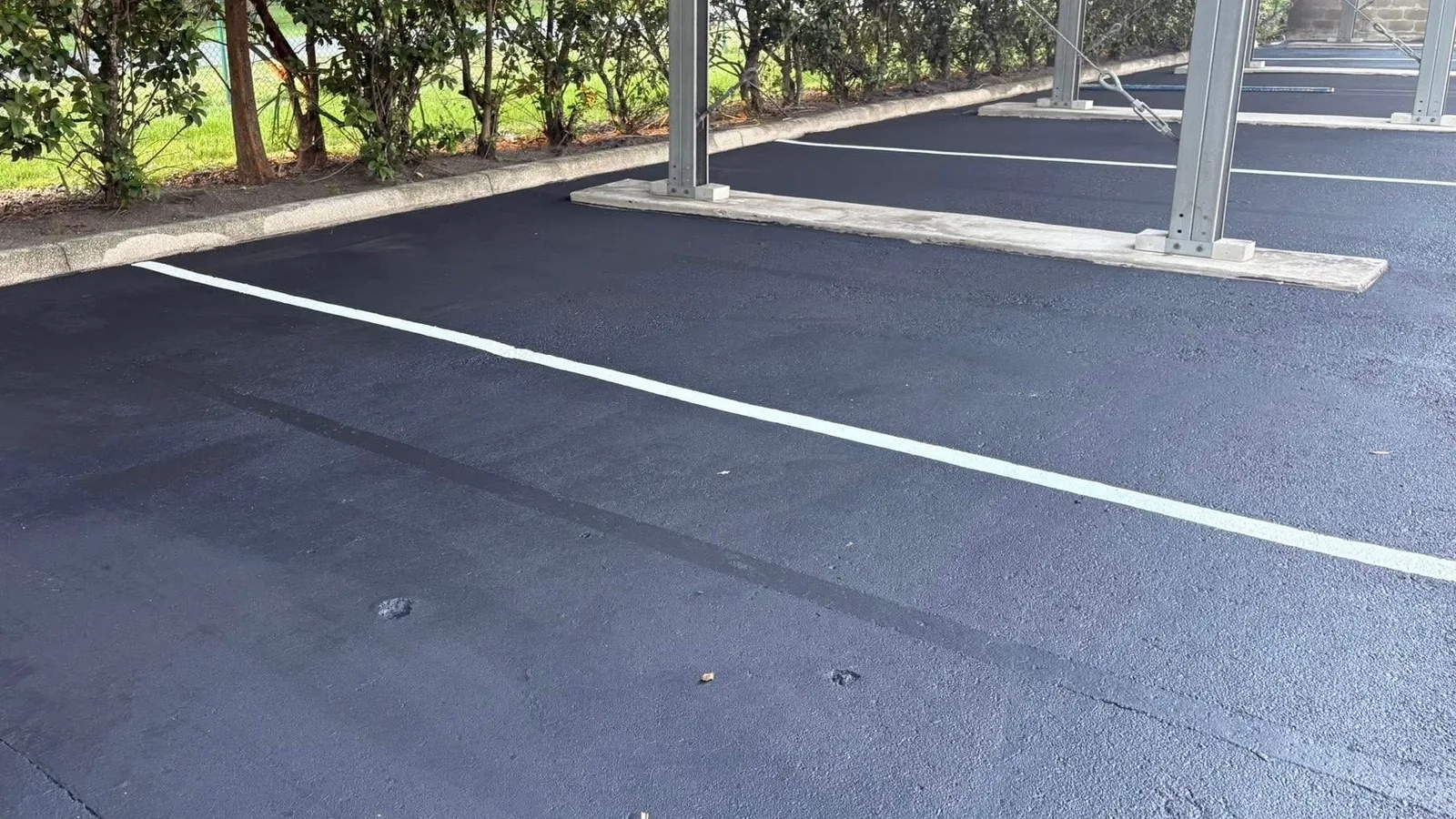
We measure the lot, lay out the stalls and put down traffic paint on new or faded pavement. The layout follows the counts, widths and slopes above. Sign posts and plan review sit outside the paint work.
If the lines on your lot are gone, call or text (979) 595-5944. We come out, measure the lot and give you a free estimate to restripe your parking lot.